
Top Benefits of Using Jindal Colour Sheet for Residential Buildings
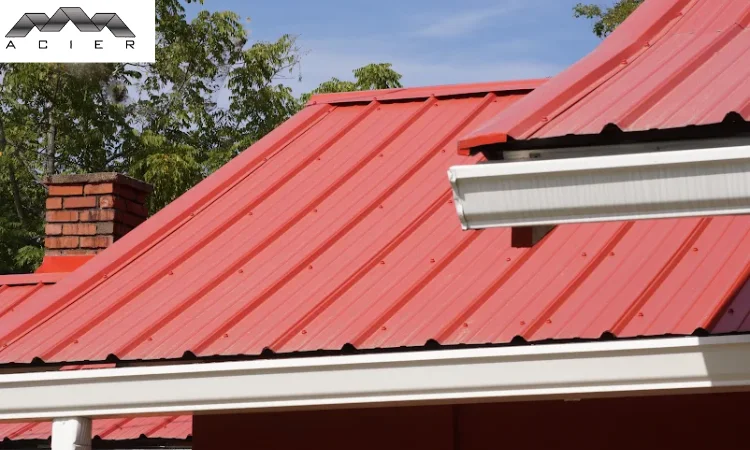
Jindal colour sheets — commercially known as Jindal Sabrang are colour-coated, Alu-Zinc galvanized steel roofing sheets manufactured by Jindal India, available in four coating grades (RMP, SMP, SDP, PVDF), thickness options from 0.16 mm to 1 mm, and multiple colours suited to both modern and traditional residential construction. For Indian homeowners, the combination of factory-applied corrosion protection, structural strength, and visible colour retention makes them one of the more practical long-term roofing choices in the sub-continent’s varied climate.
Roofing decisions are among the most consequential construction choices a homeowner makes. A roof failure in Mangalore’s coastal monsoon, or a premature coating breakdown under Rajasthan’s UV intensity, costs far more to fix than it would have cost to specify correctly at the start. This article explains what Jindal colour-coated sheets actually deliver — based on the product’s verified specifications — and where each benefit matters most for Indian residential construction.
Jindal Sabrang — Verified Product Specifications
Before discussing benefits, it is useful to understand what the product is built from. The following specifications are sourced from Acier Roofing Solutions’ product documentation and Jindal India’s published technical data. These are verified figures — not generic claims.
| Specification | Verified Detail |
| Product name | Jindal Sabrang (official name for Jindal India’s colour-coated range) |
| Base material | Zinc / Alu-Zinc coated steel (Galvanized Iron) |
| Thickness range | 0.16 mm to 1 mm (residential standard: 0.40 mm–0.60 mm) |
| Width range | 750 mm to 1,450 mm |
| Primer (top) | 3–10 micron |
| Top coat | 5–25 micron |
| Back coat | 5–10 micron |
| Coating types | RMP (Regular Modified Polyester) · SMP (Silicon Modified Polyester) · SDP (Super Durable Polyester) · PVDF |
| AZ coating options | AZ 70, AZ 150 (higher AZ = stronger corrosion resistance for coastal/humid zones) |
| Available colours | Light Blue, Off White, Brick Red, Orange, Dark Grey, Light Green (and variants) |
| Manufacturing process | Chemical clean → Chromate coat → Primer → Bake at >200°C → Dual-side colour application |
| Price range | ₹46–₹400 per kilogram (varies by thickness, coating grade, and specification) |
Key Benefits of Jindal Colour Sheet for Residential Buildings
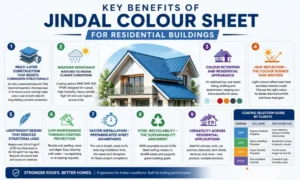
1. Multi-Layer Construction That Resists Corrosion Structurally
The corrosion resistance of a Jindal colour sheet is not a surface treatment — it is built into the manufacturing process in layers. The base is Alu-Zinc coated steel (not plain galvanized iron), which provides a base-level corrosion barrier before any additional treatment. A chemical cleaning step removes surface impurities, followed by a chromate layer to prepare the surface, then a 3–10 micron primer application, then the colour coat baked at above 200°C on both sides. Each step is additive protection, not cosmetic.
The result is a sheet that handles moisture, humidity, and airborne salt — relevant across much of India’s coastline — significantly better than plain galvanized or plain painted sheets. For residential buildings in coastal districts like Dakshina Kannada, Udupi, and the Konkan belt, the correct specification (AZ 150 base + SDP or PVDF top coat) is essential, not optional.
2. Weather Resistance Matched to Indian Climate Conditions
India’s residential construction market spans four very different roofing environments: the coastal humid belt, the high-UV semi-arid interior, the heavy-monsoon northeast and Western Ghats regions, and the cold north. Jindal colour sheets address each environment through coating grade selection — not a single product claim for all conditions.
Coating Selection Guide by Climate and Environment
| Coating | Full Name | Protection Level | Best Suited For |
| RMP | Regular Modified Polyester | Basic UV and weather protection | Cost-effective, standard use, dry/low-humidity inland areas |
| SMP | Silicon Modified Polyester | Enhanced UV resistance, better colour retention | Residential homes, moderate climate, most common for houses |
| SDP | Super Durable Polyester | High UV and humidity resistance | Humid zones, longer service life expected |
| PVDF | Polyvinylidene Fluoride | Premium corrosion + UV barrier | Coastal and high-humidity areas like coastal Karnataka |
For Mangalore specifically — a high-humidity, coastal monsoon environment with average annual rainfall above 3,500 mm — SDP or PVDF coating with AZ 150 base is the appropriate specification for residential roofing with a service life of 15+ years. Standard RMP or SMP with AZ 70 is suitable for drier inland areas.
3. Colour Retention and Residential Appearance
The UV-resistant top coat on Jindal Sabrang sheets is not simply decorative — it is one of the primary protective layers. Colour degradation in standard painted sheets typically begins with chalking (a white powdery surface residue from UV breakdown), followed by delamination. SMP and higher coating grades significantly delay this process by incorporating UV-stabilising compounds into the coating chemistry itself, not just as a surface layer.
Available colours include Light Blue, Off White, Brick Red, Orange, Dark Grey, and Light Green. These can be matched to modern contemporary exteriors or traditional residential design. Colour selection also affects thermal performance — a practical consideration, not just aesthetic.
4. Heat Reflection — The Colour Science That Matters
One of the most practically useful but least explained features of colour-coated sheets is the relationship between colour and solar heat management. Light colours reflect solar radiation; dark colours absorb it. This is established physics applied directly to roofing performance.
Colour and Solar Heat Behaviour — Residential Guidance
| Colour | Solar Behaviour | Recommended Use |
| Light Blue / Off White / Light Green | High solar reflectance | Keeps interiors cooler — recommended for hot Indian summers |
| Brick Red / Orange | Moderate reflectance | Balanced heat management, widely used in residential roofing |
| Dark Grey / Dark Brown | Lower reflectance, higher absorption | Better for cool climates; can increase indoor warmth in winter |
For Indian residential buildings in cities like Mangalore, Bengaluru, Chennai, or Hyderabad — where summer temperatures regularly exceed 35°C — Off White or Light Blue Jindal Sabrang sheets meaningfully reduce heat transfer into living spaces. This is not a marketing claim: it is a direct consequence of solar reflectance, measurable by the Solar Reflectance Index (SRI) values that coating manufacturers publish.
5. Lightweight Design That Reduces Structural Load
Steel roofing sheets are substantially lighter than clay tile, concrete, or traditional Mangalore tile roofing. A colour-coated steel sheet at 0.50 mm thickness weighs approximately 3.8–4.2 kg per square metre. Traditional Mangalore clay tiles run 40–55 kg per square metre laid. The structural load difference is significant — particularly relevant for roof extensions, home additions, and older buildings where additional dead load is a structural concern.
Lighter roofing also reduces the number of purlins and support members required, which affects material cost and installation time. For independent houses and villas, this translates directly into savings on the overall construction bill.
6. Low Maintenance Through Coating Protection
The factory-applied coating system on Jindal colour sheets reduces the primary causes of roof maintenance expense: rust formation, paint peeling, and moss or algae growth on porous surfaces. Unlike clay tile or concrete, the impermeable surface of colour-coated steel does not absorb moisture — reducing biological growth significantly in humid coastal climates.
Routine maintenance for colour-coated steel roofing consists of clearing debris from valleys and gutters at the end of each monsoon season, and a low-pressure water wash where heavy soiling occurs. No re-painting, no re-sealing, and no tile replacement. For most residential applications, this maintenance cycle remains adequate for the full manufacturer warranty period.
7. Faster Installation — Prefabricated Sheet Advantages
Colour-coated roofing sheets are manufactured to specified lengths, arrive on-site ready to fix, and require no on-site cutting beyond minor trimming at ridges and hips. A typical residential roof can be sheeted in a fraction of the time that clay tile installation requires. Acier Roofing Solutions can supply sheets cut to length — reducing site waste and installation error.
For new construction projects, faster roofing enclosure reduces weather-exposure risk to structural elements below. For roof replacement projects on occupied homes — where minimising disruption matters — the speed advantage of steel sheeting over tile is practically significant.
8. Steel Recyclability — The Sustainability Argument
Steel is one of the most recycled materials in the world. At end of service life, colour-coated steel roofing sheets can be fully recycled into new steel products — contributing no landfill waste. This is a factual characteristic of the material, not a marketing position. By comparison, cement tiles and concrete-based roofing generate significant construction waste at demolition that cannot be recycled directly.
For residential builders and architects working to green building standards or seeking sustainable material specifications, steel roofing’s recyclability is a documentable credential.
9. Versatility Across Residential Applications
Jindal colour sheets are specified across the full residential application range — from the primary roof of an independent house to secondary structures:
- • Primary roofing: Independent houses, villas, farmhouses across all Indian climate zones
- • Secondary structures: Parking sheds, car porch roofs, compound covers, service area roofing
- • Balcony and terrace covers: Fixed and semi-permanent overhead protection
- • Agricultural and rural: Farm sheds, storage structures, poultry and livestock housing
- • Institutional: Schools, community halls, smaller commercial buildings
The same product — varied only in thickness, coating grade, profile, and colour — handles all of these applications. This versatility reduces procurement complexity for builders and contractors managing multiple project types.
How to Choose the Right Jindal Colour Sheet for Your Home
Six factors determine the correct specification for a residential roofing project. Getting these right at the purchase stage avoids expensive rectification later.
1. Climate and location. This is the primary variable. Coastal and high-humidity areas need higher AZ coating (AZ 150) and premium top coats (SDP/PVDF). Dry inland areas can use AZ 70 with SMP. Confirm your district’s rainfall and humidity profile with the supplier.
2. Roof pitch and span. Steeper pitches can use lighter (thinner) sheets. Flatter pitches require thicker sheets and must be designed with appropriate overlap and sealant to prevent water ingress. Very flat roofs are not suitable for profiled steel sheeting without proper drainage design.
3. Sheet thickness. For standard residential roofing, 0.47mm–0.50mm is the most common specification. Use 0.55mm or above for longer spans, higher wind zones, or heavier monsoon loads.
4. Colour and solar performance. For hot summers, choose light colours (Off White, Light Blue, Light Green). For year-round comfort balance, brick red or orange are widely used. Dark grey is aesthetically flexible but thermally warmer — verify your region’s cooling needs.
5. Verified supplier. Buy from an ISI-certified, authorised dealer. Acier Roofing Solutions in Mangalore is an authorised supplier of Jindal Sabrang sheets with product documentation available on request.
6. Warranty documentation. Ask for the warranty in writing before purchase. Understand what is covered (coating adhesion, colour retention, perforation corrosion) and for how many years under your specific coating grade.
Common Mistakes to Avoid When Buying Jindal Colour Sheets
Most roofing problems that appear within five years of installation can be traced to one of these decisions:
- • Choosing by price per kg alone. A thinner sheet with a lower coating grade costs less upfront but may require replacement or significant repair within ten years in a coastal humid environment. The correct specification delivers better lifetime cost, not the cheapest unit price.
- • Ignoring the AZ coating value. AZ 70 and AZ 150 are not equivalent. For coastal Karnataka, Goa, Kerala, or any area within 5 km of the sea, AZ 150 is the minimum appropriate base coating.
- • Using RMP coating in high-UV or coastal areas. RMP is a standard polyester coating suited to moderate conditions. In high-UV or high-humidity environments, it degrades faster than SMP or SDP. This is a coating selection error, not a product defect.
- • Incorrect fastener selection. Self-drilling fasteners must be matched to sheet thickness and substrate type. Oversized holes, wrong thread pitch, or missing EPDM washers are common installation errors that cause water ingress years before the roofing sheet itself fails.
- • Buying without checking product authenticity. Substandard imitation product is present in the Indian market. Buy from ISI-certified authorised dealers with invoice documentation and batch traceability.
- • Ignoring ventilation design. Steel roofing without adequate ventilation below the sheet creates condensation on the underside — visible as dripping or rust staining. Ventilation design is part of the roofing system, not an afterthought.
- • No warranty documentation at purchase. Verbal assurances are not a warranty. Confirm the warranty document, its coverage, and the process for making a claim before accepting delivery.
The Case for Specifying Correctly from the Start
Jindal Sabrang colour-coated sheets — available through Acier Roofing Solutions in Mangalore — offer Indian homeowners a roofing material with documented multi-layer corrosion protection, coating options matched to India’s varied climates, verified structural strength at low dead weight, and a colour range suitable for both modern and traditional residential architecture.
The benefits above are material-specific and specification-dependent. An SMP-coated 0.50mm AZ 70 sheet performs differently from a PVDF-coated 0.60mm AZ 150 sheet — both are Jindal Sabrang, both are colour-coated, but their appropriate applications are distinct. Understanding this distinction is what separates a 20-year roof from a 7-year roof, in the same building, in the same climate.
Looking for quality roofing solutions in Mangalore? Acier Roofing Solutions supplies ISI-certified Jindal Sabrang colour-coated sheets, JSW Colouron, aluminium and galvanized sheets — with expert guidance on thickness, coating selection, and installation.
Visit us at Baikampady Industrial Area, New Mangalore. Call: 8904677040 | Email: info@acierroofing.com
Frequently Asked Questions — Jindal Colour Sheet
1. What are Jindal colour sheets used for?
Jindal colour sheets (officially named Jindal Sabrang) are colour-coated Alu-Zinc galvanized steel roofing sheets used across residential, commercial, industrial, and agricultural construction in India. Residential applications include independent house roofing, villas, farmhouses, parking sheds, balcony covers, and terrace enclosures. They are available from Acier Roofing Solutions in Mangalore in multiple thicknesses, coating grades, and colours.
2. Are Jindal colour sheets good for residential roofing?
Yes. Jindal Sabrang sheets offer a practical combination of structural strength (available from 0.16mm to 1mm thickness), multi-layer corrosion protection (Alu-Zinc base, chromate layer, primer, and colour-coat baked above 200°C), and colour options that suit Indian residential aesthetics. The correct coating grade (RMP, SMP, SDP, or PVDF) must be selected based on local climate conditions.
3. How long do Jindal colour sheets last?
Service life depends on coating grade and local environment. SMP-coated sheets typically outlast RMP in high-UV or moderate-humidity conditions. PVDF and SDP coatings are specified for coastal or high-humidity environments where longer service life is needed. Proper installation — correct fasteners, adequate ventilation, appropriate overlap — is equally important to maximising sheet life.
4. Do colour-coated roofing sheets reduce heat?
Yes, based on colour selection. Light colours such as Off White, Light Blue, and Light Green have higher solar reflectance and reduce heat transfer into the living space — an important consideration for Indian summers. Dark Grey and similar dark shades absorb more solar energy and are thermally better suited to cooler or winter-dominant climates. Acier Roofing can advise on the right colour for your region.
5. Are Jindal roofing sheets resistant to rust and corrosion?
Yes. The Alu-Zinc steel base provides corrosion resistance before any surface treatment. The manufacturing process adds chemical cleaning, chromate coating, primer, and a dual-side colour coat baked above 200°C. For coastal Karnataka — high humidity, salt-laden air, heavy monsoon — Acier Roofing recommends AZ 150 coating with SDP or PVDF top coat for appropriate long-term corrosion resistance.
6. Which thickness is best for residential roofing sheets?
For most residential applications, 0.47mm–0.50mm is the standard specification. This provides adequate structural strength for normal residential spans and wind loads while remaining manageable in weight and cost. For longer spans, steeper roofs in high-wind zones, or heavier monsoon load requirements, 0.55mm–0.60mm is recommended. Acier Roofing can advise on the appropriate thickness for your specific construction.
7. Are Jindal colour sheets suitable for coastal areas?
Yes, with the correct specification. For coastal Karnataka — including Mangalore, Udupi, and the broader coastal belt — Acier Roofing recommends Jindal Sabrang sheets with AZ 150 base coating and SDP or PVDF top coat. This combination provides appropriate resistance to salt spray, high humidity, and the heavy monsoon rainfall characteristic of the region. Standard AZ 70 with RMP or SMP coating is better suited to drier inland locations.